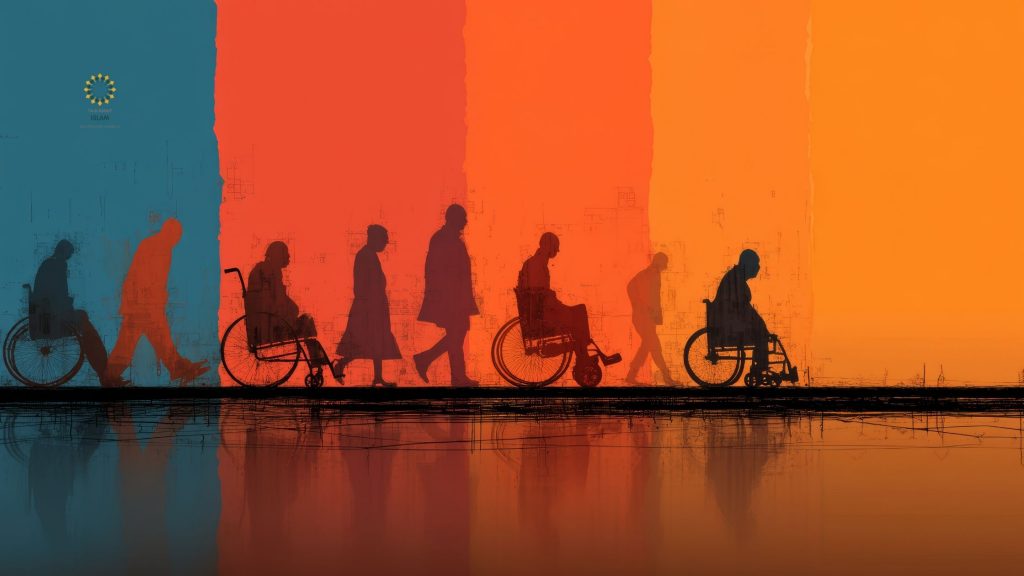
Disability is mostly discussed through the language of pity. People are praised for “overcoming” the condition, treated as permanent recipients of charity, or quietly excluded because others assume they cannot actively participate. But Islam begins elsewhere. Through the Islamic lens, human dignity does not depend on physical strength, appearance, wealth, independence, or social influence.
The Holy Qur’an says that Allah has honoured the “children of Adam.” This is a universal expression. It does not reserve dignity for the healthy, powerful, or just Muslims. It places honour within human life itself. This matters when around 1.3 billion people, about one in six worldwide, live with a significant disability, while many of their difficulties arise from discrimination and inaccessible services rather than the condition alone.
Human Worth Is Not Measured by the Body
Modern societies often value people according to productivity, attractiveness, income, or physical independence. Islamic teaching rejects that apparent measure. Prophet Muhammad (PBUH) taught that:
“Allah does not judge people by their faces or wealth, but by their hearts and deeds.”
Disability does not automatically make someone morally superior, and Islam does not romanticize suffering. It means that bodily difference neither lowers a person’s value nor prevents spiritual excellence. A wheelchair, white cane, hearing aid, speech difference, or chronic illness says nothing about a person’s honesty, intelligence, courage, or nearness to Allah.
Nor is disability proof of divine punishment. Health is not evidence that Allah is pleased with someone, just as illness is not evidence of His rejection. In fact, Islamic accountability is based on intention, character, choices, and genuine capacity.
When the Qur’an Defended a Blind Man’s Dignity
One of the Qur’an’s clearest lessons appears at the beginning of Surah Abasa. In the well-known Islamic account, a blind man named Abdullah ibn Umm Maktum approached Prophet Muhammad (PBUH) seeking guidance while the Prophet was speaking with influential leaders of Makkah.
The Qur’an recorded the incident and redirected attention towards the sincere seeker rather than the socially powerful audience. Abdullah deserved attention not merely because he was blind, but because he was a human being seeking knowledge. His lack of sight or status did not make his request less important.
A moment involving a blind man became part of scripture recited by millions. It challenges every society that gives priority to wealth, appearance, and influence while overlooking people it considers less useful.
Disability Did Not Prevent Leadership
Abdullah ibn Umm Maktum was not confined to receiving sympathy. Authentic reports state that he gave the call to prayer in Madinah, one of the city’s most recognized religious duties. Prophet Muhammad (PBUH) also appointed him to oversee Madinah in his absence on two occasions.
Ultimately, he was trusted with greater responsibility. The example corrects a common mistake. Respecting disabled people does not mean speaking kindly while excluding them from meaningful roles. It means recognizing ability, making reasonable adjustments, and allowing people to contribute through their knowledge and strengths. Someone may need assistance in one area while being highly capable in another.
Accommodation Is Justice, Not Favoritism
Islamic worship is especially built around responsibility according to ability. The Holy Qur’an removes blame from those who are blind, physically disabled, or ill when a duty exceeds their capacity.
The same principle appears throughout Islamic practice. A person who cannot stand may pray while seated or lying down. Someone whose illness would be worsened by fasting may be exempt. Pilgrimage is required only from those able to undertake it. These are not lesser forms of worship, and the person using an accommodation is not spiritually inferior.
The Barriers Are Often Built by Society
The World Health Organization (WHO) notes that many inequalities faced by disabled people arise from stigma, poverty, inaccessible transport, exclusion from education and employment, and barriers within healthcare. Islam’s language of dignity, therefore, has practical consequences.
A mosque cannot praise inclusion while its entrance excludes wheelchair users. A sermon is not open to everyone when deaf worshippers have no interpretation or transcript. Likewise, religious education fails when children with autism, intellectual disabilities, or sensory needs are treated as disruptions rather than students.
Meaningful inclusion may require ramps, accessible washrooms, clear signs, suitable seating, large-print or audio material, and teachers trained for different learning needs. It also requires courtesy, for instance, speaking directly to the disabled person, asking before offering help, and not treating an adult like a child.
The Right to Belong
Islam’s approach to disability begins with a universal truth that every child of Adam carries God-given dignity. Physical ability may shape how someone moves, communicates, works, or worships, but it does not determine human worth.
The Holy Qur’an defended a blind seeker when attention was directed towards powerful men. Prophet Muhammad (PBUH) entrusted that same man with visible religious and civic duties. Moreover, Islamic law adapted obligations to people’s real capacities without treating them as spiritually lesser.
In a nutshell, the failure begins not in the disabled body, but in a society that refuses to make room.